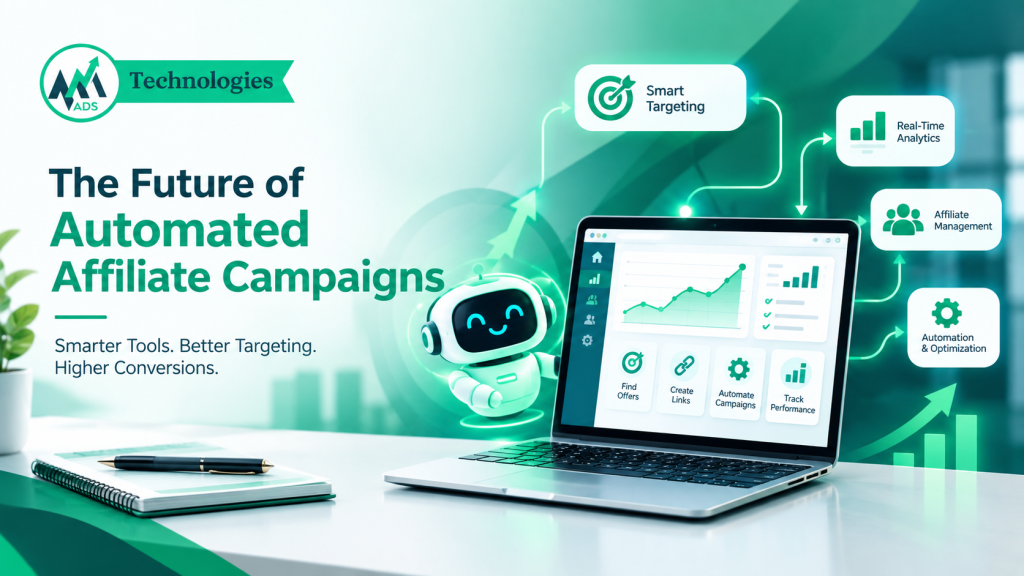
The Campaign That Runs Itself Is No Longer a Fantasy
Not long ago, the idea of an affiliate campaign that monitors its own performance, reallocates its own budget, rotates its own creatives, and filters its own traffic sounded like something out of a tech keynote presentation rather than something a real marketing team would actually use. That gap between aspiration and reality has closed faster than most people in the industry expected.
In 2026, automated affiliate campaigns are not a niche experiment being run by a handful of well-funded tech companies. They are the operating standard for any performance network serious about delivering consistent results at scale. The brands, publishers, and networks that understand this shift are pulling ahead quickly. Those still relying on manual campaign management are finding it harder and harder to keep up.
At Mmads Tech, Asia’s fastest growing performance network, automation is not a feature we bolt onto campaigns as an afterthought. It is woven into how every campaign in our network is built, monitored, and optimized from day one. Here is a thorough look at where automated affiliate campaigns are heading, what the key developments mean for advertisers and publishers, and why choosing the right network to run them through makes all the difference.
“The future of affiliate marketing does not belong to the brand with the biggest team or the publisher with the most traffic. It belongs to whoever can make their campaigns smarter, faster, and more responsive than everyone else’s.”
Why Manual Campaign Management Is Hitting Its Limits
To understand why automation is the future, it helps to be honest about why manual management is the past. A campaign manager overseeing even a moderately sized affiliate program is making hundreds of micro-decisions every week: which publishers to prioritize, where to shift budget, which offers to pause, which creatives to rotate out, how to respond to a sudden traffic quality drop. Each of these decisions requires time to spot, time to analyse, and time to act on.
The problem is that the speed at which digital campaigns move has outpaced what any human team can comfortably manage without dropping the ball somewhere. A publisher’s conversion rate can shift meaningfully within hours. A traffic source can turn fraudulent overnight. A competitor can undercut your offer payout and pull your best publishers away before you even notice. By the time a human reviews the weekly report and flags the issue, the damage is already done.
Automation solves this by compressing that response time from days or hours down to seconds. An automated system does not wait for the weekly report. It catches the anomaly the moment it appears in the data and acts on it immediately, whether that means pausing a publisher, reallocating budget, or triggering an alert for a human to review a more complex situation. The result is a campaign that never goes untended, even at 3am on a Sunday.
The Scale Problem That Only Automation Can Solve
There is also a pure scale problem with manual management that becomes impossible to ignore as a network grows. Managing 50 publisher relationships manually is hard work, 500 is a full-time team job, 1,500 the way Mmads Tech does, with the consistency, responsiveness, and optimization discipline that top-performing campaigns require, is only possible with intelligent automation running underneath the human layer.
This is one of the clearest competitive advantages that large, well-structured affiliate networks have over smaller, manually managed setups. The automation infrastructure that Mmads Tech has built does not just help individual campaigns perform better. It raises the performance floor across the entire network, because every advertiser and every publisher benefits from a system that is continuously learning from the collective data of thousands of simultaneous campaigns.
The Core Technologies Driving Affiliate Campaign Automation
Automation in affiliate marketing is not a single technology. It is a stack of interconnected systems, each handling a specific layer of campaign management, that together produce something far more capable than any one of them could achieve alone. Understanding what these layers are helps both advertisers and publishers ask the right questions when evaluating which network to trust with their campaigns.
Rules-Based Automation: The Foundation Layer
The most straightforward form of campaign automation is rules-based: if a publisher’s conversion rate drops below a defined threshold for more than two hours, pause their traffic allocation. If daily spend reaches 80% of the budget cap by noon, throttle impression delivery for the rest of the day. If a new publisher generates 500 clicks with zero conversions, flag them for review.
These rules sound simple, but when applied consistently across thousands of campaigns simultaneously, they eliminate an enormous volume of performance leakage that would otherwise go unnoticed in a manually managed setup. Rules-based automation is the foundation that every well-run automated affiliate campaign is built on, and it is the baseline that any serious performance network should be running without exception.
Machine Learning Optimization: The Intelligence Layer
Above the rules layer sits machine learning, which handles the decisions that are too nuanced for a simple if-then rule. ML models look at the full picture of campaign data, including publisher behaviour patterns, audience signals, time-of-day performance variations, offer-traffic compatibility, seasonal trends, and dozens of other variables, and continuously update their optimization decisions based on what the data is actually showing.
A machine learning model managing a CPA campaign does not just react to performance drops. It anticipates them. If historical data shows that a particular publisher’s conversion rate typically dips on Thursday afternoons and recovers by Friday morning, the model accounts for that pattern in its allocation decisions rather than treating every Thursday afternoon dip as an emergency. This kind of contextual intelligence is what separates genuine campaign optimization from basic performance monitoring.
Programmatic Automation: The Distribution Layer
At the traffic distribution level, programmatic automation handles the real-time buying and placement decisions that determine which audience sees which offer at which moment. Programmatic affiliate marketing combines the precision of audience data with the speed of automated bidding to place offers in front of users whose behaviour signals genuine purchase intent, at the exact moment when that intent is highest.
Mmads Tech’s Audience Network is built on exactly this kind of programmatic infrastructure. Advanced algorithms and data analytics work together to optimize ad placements across a wide range of digital channels in real time, giving advertisers the audience reach of a broad network with the conversion accountability of a performance-based pricing model.
The more campaigns run through an automated network, the smarter that network’s optimization becomes. Every new advertiser and publisher on the Mmads Tech network adds data that improves the performance of campaigns already running there. This compounding effect is one of the most powerful and least discussed advantages of partnering with a large, established performance network rather than a smaller manual operation.
What Automated Campaigns Mean for Advertisers in Practice
For an advertiser running campaigns through an automated affiliate network, the most immediate and visible change is in how budget efficiency improves. In a manually managed campaign, some portion of the budget is almost always being spent on publisher-offer combinations that are underperforming, simply because the team has not had time to spot and fix the issue yet. Automated optimization eliminates that lag and ensures that budget is always flowing toward what is actually converting.
Beyond efficiency, automation dramatically reduces the management overhead required to run a sophisticated affiliate program. An advertiser working with Mmads Tech does not need an in-house team of campaign managers monitoring their affiliate spend around the clock. The network’s automated systems handle the continuous optimization, and the dedicated Mmads Tech account team provides the strategic guidance and relationship management that sits above what automation can handle on its own.
Automation also makes scaling significantly less intimidating. In a manual setup, doubling campaign spend often means doubling the management workload. In an automated setup, the system scales with the budget without requiring a proportional increase in human oversight. An advertiser can move from a test budget to a full-scale campaign without the infrastructure bottleneck that has historically made scaling affiliate programs so operationally demanding.
What Automated Campaigns Mean for Publishers in Practice

Publishers often think of automation primarily as something that benefits advertisers, but the advantages on the publisher side are just as significant. The most important is intelligent offer matching. Rather than manually browsing a network’s offer library and guessing which products will resonate with their specific audience, publishers on an automated network benefit from recommendation engines that match offers to their traffic profile based on real performance data.
For a publisher running a personal finance blog in India, this might mean being automatically surfaced the fintech app install offers that have historically converted well on similar traffic, rather than having to sift through hundreds of irrelevant e-commerce offers to find them. Better matches mean better conversion rates, better EPC, and a more sustainable publishing income over time.
Automation also protects publishers from being undercut by low-quality traffic from other sources in the network. When fraud detection systems are running continuously and automatically, genuine publishers do not have to compete against bot-driven click farms that inflate volume metrics and drive down the value of real traffic. Clean traffic standards benefit everyone who is bringing genuine audiences to the network, and automated fraud detection is the only practical way to enforce those standards at scale.
Hyper-Personalization: The Next Frontier of Automated Campaigns
The next wave of development in affiliate marketing automation is moving beyond campaign-level optimization toward individual-level personalization. The vision, which is already being partially realized by the most advanced networks, is a campaign that serves a different version of itself to every single viewer based on that viewer’s unique combination of interests, behaviour history, location, device, and real-time context.
An app install campaign for a food delivery service, for example, might show a version highlighting restaurant variety to a user whose browsing history suggests they eat out frequently, a version highlighting delivery speed to a user in a dense urban area who has searched for quick meal options, and a version highlighting first-order discounts to a user who has previously abandoned similar apps without converting. All three versions are running simultaneously, automatically, without a creative director having to manually build and assign each one.
This level of personalization at scale is where automated affiliate campaigns are heading, and the networks investing in the data infrastructure and algorithmic capability to deliver it today will be the ones setting the performance standard for the next five years. Mmads Tech’s ongoing investment in its Audience Network and programmatic capabilities is positioning us to be at the front of that curve across Asian markets.
The Role of Real-Time Reporting in Automated Campaigns
Automation only delivers its full value when it is paired with complete transparency. An automated system making decisions that neither the advertiser nor the publisher can see or understand is not a performance tool; it is a black box that breeds mistrust and makes it impossible to learn from what is happening. Real-time reporting is what transforms automated campaign management from an opaque process into a genuine partnership between the network, the advertiser, and the publisher.
At Mmads Tech, every partner has access to live dashboards that show exactly what is happening across their campaigns at any given moment. Every click, every conversion, every budget movement, and every optimization decision is visible in real time. This transparency means advertisers can see the value their automated campaigns are generating and make informed decisions about where to scale, and publishers can track their earnings with the confidence that the numbers they see reflect what they have actually earned.
“Automation without transparency is just a machine making decisions you cannot see. The best automated affiliate campaigns give you full control and full visibility at the same time, which is exactly what Mmads Tech is built to deliver.”
What to Look for in an Automated Affiliate Network
Not every network that claims to offer automated campaign management is actually delivering it at the same level of sophistication. For advertisers and publishers evaluating their options, here are the things that genuinely matter when assessing whether a network’s automation infrastructure is worth trusting.
First, ask about fraud detection. Automated fraud filtering is non-negotiable in 2026, and any network that cannot clearly explain how it detects and removes fraudulent traffic in real time should be treated with caution. Second, look for genuine real-time reporting rather than dashboards that update once a day and call themselves live. Third, ask about offer matching: does the network have an intelligent system that recommends offers to publishers based on performance data, or are publishers left to browse manually? Fourth, and perhaps most importantly, evaluate the human layer that sits alongside the automation. A great automated network still needs experienced people to handle the strategic questions that algorithms cannot answer.
Mmads Tech clears every one of these bars, which is why global brands with high performance marketing standards choose to run their campaigns through our network, and why publishers who have worked with multiple networks consistently stay with us once they experience the difference that genuine automation infrastructure makes to their earnings.